When To Take The Noise-Canceling Headphones Off: Curious, Nosey, or Indifferent
There's a thin line between being nosey about someone and being curious about them and it comes down to what you're looking for. Nosiness is closed-minded: you're gathering information about a person to confirm a story you've already written about them, usually an unflattering one and it could even be for an interview candidate. Every new detail gets filed under "see, I knew it." You're not actually learning anything because you've already decided what's true and sometimes, you can get away with that and sometimes you cannot (i.e. it catches up with you). Curiosity is the opposite posture. You go in admitting you don't fully understand someone and you let what you observe revise your picture of them rather than reinforce it. The nosey person collects evidence (picks and chooses data points to reaffirm their beliefs); the curious person updates (learns/unlearns) and stays curious.
Now who wins? Who gets what they want?
I think about this when I remember taking Graduate-level classes as an undergrad. I was surrounded by people who were a few steps ahead of me, that were older, came from industry or the west-coast (for some reason, more often than not, a significant amount of the Grad-students in my classes came from the UC schools) and the most valuable thing wasn't just the lecture material, it was getting to watch how Grad-students actually worked. How they read a paper, how they asked questions, how they handled not knowing something, how they organized their time and their thinking. In one example, I still remember for one of my Grad-level plant classes there was a Grad/PhD-student (who was part of a lab) who wanted to figure out how to breed and plant hazelnut trees in New Jersey, and he was successful and I see them when I drive-by and grab coffee and every time I see them it still inspires me to want to work on long-term (maybe high-risk) but high-reward and do-able projects, because why not.
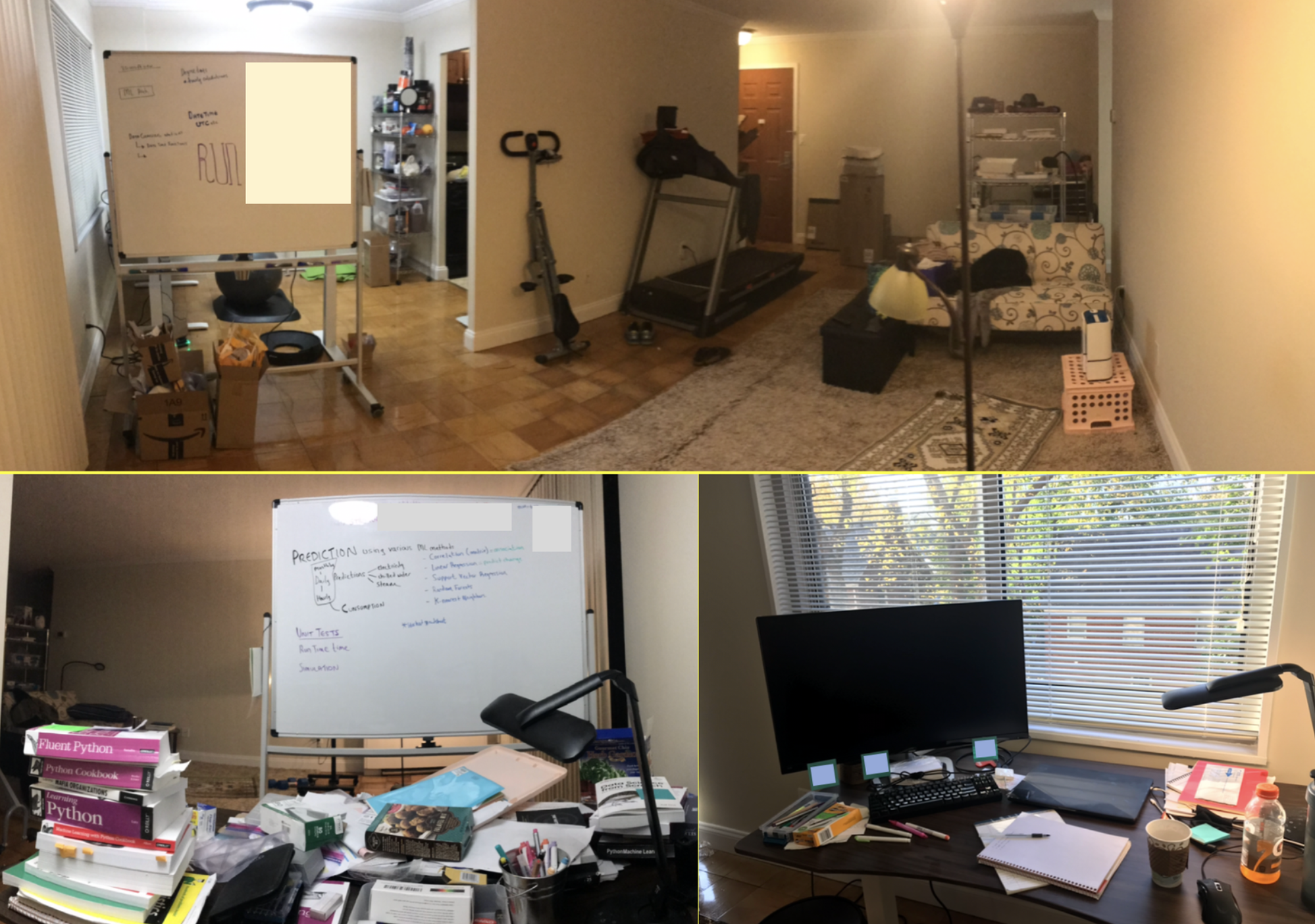
But anyway, none of that gets written down in a syllabus. You absorb it by being in the room, paying attention, and staying open to the possibility that someone has figured out something you haven't. That's the real argument for proximity: if you're curious instead of nosey, just being around people who are good at something teaches you more than any amount of studying them from a distance ever could. I learned this in industry, I’ll go as far as to say that one of the reasons I purchased a whiteboard for my home-office setup in my apartment in Bethesda was because one of my co-workers (serverless-systems designer) had one to use behind him in his Zoom meetings with me.
Two memories make the contrast concrete for me and so hear me out. In undergrad, in my algae bioinformatics lab where I worked as a bioinformaticist, I would take my headphones off the moment the PI started talking to his Post-docs and Grad students, because he always had something worth hearing, and the back-and-forth that followed was an education in itself. I wanted to be in that conversation, or at least within earshot of it, and that instinct to lean in was curiosity in its plainest form. Staying curious there cost me nothing and gave me a great deal in my career years later. At Penn, by contrast, I kept my noise-cancelling headphones (I purchased my own pair for work a few weeks into my position before they were handed out to everyone months later which is also symbolic in it's own way) on all the time. I had assessed, fairly early, that the people immediately around me had little to teach me. The point worth making is that curiosity is not the same as indiscriminate openness. Being curious means staying genuinely receptive to learning from people who have something to offer; it does not oblige you to treat every room as equally worth your attention. Discernment is part of the discipline. In that environment I made a judgment about where the value was (and it was not there) and where it wasn't (again, not there), and my trajectory afterward, into more competitive institutions and industry where the people around me consistently raised my game, told me the judgment was sound. That will always be true.
The skill, in the end, is knowing the difference: leaning in hard when there is real expertise in the room, and being honest with yourself when there isn't, so that your curiosity is spent where it actually compounds.
Which leaves the third posture, the one I'd warn against most: indifference. The nosey person and the curious person are at least both paying attention, one to confirm and one to learn. The discerning person is paying attention too, just choosing carefully where to aim it. The indifferent person has stopped paying attention altogether. They aren't exercising judgment about which rooms are worth their time; they've simply stopped asking the question, and a closed door looks the same whether you shut it deliberately or just never opened it. Nosiness wastes your attention, but indifference forfeits it. Of the ways to be in a room full of people, that's the only one that guarantees you learn nothing and sometimes, that could be what you want.
Edit. I think instead of his Grad-student, it was Prof. M o l n a r himself who may have made a mini-speech about his work in one of my Grad-level plant classes. Delving deep in to this, it was his PhD thesis to want to grow hazelnuts in NJ which he continued to work on as a Professor at Rutgers and was successful in doing. I pass by them, I think about that almost everyday since I moved back to my hometown a few years ago.
References
https://newjerseymonitor.com/2026/06/16/new-jersey-hazelnut-farmers/
"Treasure your attention" https://www.instagram.com/reel/DYVRDyDlRh8/